Waterloo Recreation Area · Jackson & Washtenaw Co., Michigan
The Camps of Waterloo
A WWII POW & CCC history tour
This is the one tour I'd never let a visitor skip. In a single unbroken loop you'll walk the work camps the Civilian Conservation Corps built in the Great Depression, the field where German prisoners of war were held through the last years of the war, and the prison ground each site became — all inside Michigan's largest Lower-Peninsula park. Keep me in your pocket: I'll handle the route and the surfaces and tell you each site's real story the moment you reach it.
21,000+ acresBuilt by the CCC, 1935–43German POW camp, 1944–45Scooter-rated surfacesOffline-ready
Before you roll out
Plan & kitA patchwork park — smooth county pavement in places, loose gravel and sand in others. The drawers below hold the prep, the offline-map setup, and where to leave the car. Read the prep once; open the rest as you need it.
Quick prep — read this once
Recreation Passport — required on your plate only to park a vehicle in a state lot (Eddy, HQ, Portage), not to enter on foot or scooter. To reach the POW field free, skip the lots and park on a public road shoulder (see Where to leave the car). Fold & walk — carry a light lock. Where a leg turns to gravel or dirt (the surface badges tell you where), fold the deck, lock it, and walk — especially the last approach to the POW field and any natural-surface trail. Season & hours — the Eddy Discovery Center is closed Mondays and runs weekends-only in winter; verify before relying on its restrooms or staff. Hunting — most of the park allows hunting outside the safety zones; in autumn, wear blaze orange and keep to the trails. Respect & Leave No Trace — private parcels and former corrections land thread through the park. View from public roads and trails, cross no fences or posted/active facility land, and disturb nothing — these old foundations are fragile history. Weather — every stop and hub has a weather button to the National Weather Service hourly forecast for that exact spot (needs signal).
Offline maps that work with no bars
Parts of the park — the Maute Road area especially — have weak or no cell service. Cache a real, georeferenced map before you go and your blue dot still tracks with zero bars. Avenza Maps (free) is simplest: install it, search its Map Store for “Waterloo Recreation Area,” and download the Michigan DNR map on wi-fi. In the park, tap locate and your position rides the real map, offline. (Gaia GPS and onX work the same way.) These official maps double as your authoritative paved-vs-gravel reference.
The first three are paved, legal, Passport-required state lots — pick by which end you're touring; our tour starts at the Eddy Center. The fourth is a free, no-Passport roadside drop for the POW field, for when you'd rather not buy a pass.
Primary base · start here · east cluster
Gerald E. Eddy Discovery Center
17030 Bush Rd, Chelsea · 42.32258, −84.08650
Paved lot, restrooms, water, staff, accessible trails, and indoor history exhibits. I-94 Exit 157 (Pierce Rd) north, then Bush Rd. Closed Mondays; winter weekends only.
The park office, in the old Sylvan Estates clubhouse — paper maps, a Passport drop, and current closure notices. East cluster, I-94 Exit 156, about a mile west of the Discovery Center. Worth a stop before the long drive west to the remote POW field (~4 mi).
Off Seymour/Mount Hope Rd, Grass Lake · 42.32812, −84.24162
Paved lot, restrooms, sand beach, playground, seasonal concessions — the most developed hub, about 10–15 min west of the POW area. I-94 Exit 150 (Mount Hope Rd) north.
From I-94 Exit 153 (Clear Lake Rd) go north ~2 mi to Maute Rd, pull fully onto the paved Clear Lake Rd shoulder at the corner (legal where unposted, no Passport), then ride or fold-and-walk ~0.8 mi south down gravel Maute Rd to the field. It's remote and unstaffed — lock the deck, take valuables, and view the site from the public road only.
I-94 exits: 157 Pierce Rd (Discovery Center) · 156 (Area HQ) · 153 Clear Lake Rd (POW field) · 150 Mt Hope Rd (Portage/west) · 159 Chelsea. The Waterloo–Pinckney and Border-to-Border trails cross the park — not part of this tour, but you'll pass their markers.
Field instrument
Locate meUses your phone's GPS to show live distance & compass bearing to every site, and to drop a "you are here" marker on the map.
Position fix
Tap to read your GPS — distances and bearings fill in below and a marker drops on the map. Works offline as long as GPS is allowed. (Opened straight from the Files app, Safari sometimes blocks GPS; if so, the "Open in Apple Maps" buttons on every stop still work.)
If you need help — read this to 911
—
Decimal degrees (lat, long). Give the dispatcher these numbers plus the nearest road; this works even where there's no street address.
Hands-free: as you reach each site, I'll tell you its story aloud. Handlebar mode opens a big, glanceable screen for the bars.
Narration voice
Auto
Tap a voice to audition it — the whole tour follows your choice.
Pace
Voices live on your phone, so narration keeps working with no signal — voices marked "needs signal" are the exception. For a richer storyteller, install an Enhanced voice under Settings → Accessibility → Spoken Content → Voices, then reopen this page. Your pick holds for this visit; nothing is stored.
Orientation map
The lay of the landThe real park map of your route — an east cluster (the Discovery Center & Cassidy Lake, near Chelsea) and a west cluster (the POW camp, near Waterloo village). Tap a numbered pin to jump to its stop, or tap Routes and a numbered leg for its distance, surface, and ride/walk/drive time. Tap Plain map for the crisp original.
Plan the route
Estimates · scooter ~9 mph, walk ~3, car ~28 · road distance ≈ straight-line ×1.4. Tap a numbered leg on the map.
POW / War (climax)CCC campCorrections-eraEddy base / startFarm museumYou are here (GPS)
The genuine Michigan DNR park map, tinted to match these pages — tap Plain map for the crisp original. Numbered pins mark the six stops in tour order; a live GPS fix drops the “you are here” dot. An orientation aid, not turn-by-turn — use each stop’s GPS links to navigate, and the map’s own key for road & trail surfaces.
The tour · six stops in order
The journey, stop by stopFollow the stops in order, or tap any to open it. In Tour Mode the story plays as you arrive; rate each stop and your guide will suggest where to wander next. Live distance & bearing fill in after a position fix.
Start here — it's where I start everyone. The center is really about Waterloo's geology and habitats, but it sets the table for the human story too: Paleo-Indian spear points, a dug-out canoe, and rangers who know this park cold and can tell you exactly how the camp sites stand today. The paved loops right outside the door are the smoothest, easiest walking in the whole park.
Catch your breath, then let's move — the first of the old work camps is a short walk down toward the water. Fold the scooters and go on foot; the path turns to soft ground fast, and that's walking country.
Practical — coordinates, hours & getting there
Coordinates
42.32258, −84.08650
Hours
Closed Mondays; weekends-only in winter; roughly 10–5 (10–4 off-season) — verify before you go
Has
Restrooms, water, info, paved/accessible trails, free track-chair on request
From you
—
Asphalt Paved lot and accessible loops — the smoothest riding and walking in the park.
Discovery Center foot trails (round trip, smoothest first): Old Field 0.8 mi · Spring Pond 1.0 · Lowland 1.1 · Oak Woods 1.3 · Bog 1.5 · Lakeview 3.0 · Hickory Hills 4.2. The stroller-friendly loops are fine to ride; the dirt trails are for walking.
Mill Lake, right beside the Discovery Center, is where the story opens — on a melancholy note. In the depths of the Depression, young men rode out here from Detroit, eighty to a hundred at a time, earning a dollar a day — thirty a month, most of it mailed straight home — to plant trees, dig ponds, and build the very park you're standing in. They put more than 350,000 seedlings into this worn-out ground. Of the 28 buildings that once stood here, about half survive, and they're slowly losing their fight with the weather.
Don't let the ruins get you down — because next I'll show you how the story could have gone instead. Back on the scooters: an easy paved run east lands you at Cedar Lake, where a camp just like this one is still standing, whole and in use.
Practical — coordinates, access & getting there
Coordinates
≈42.3205, −84.0925 (near the Eddy Center)
Era
CCC-built group camp; later served inner-city youth
Today
About half of the original 28 buildings still stand, deteriorating with disuse
From you
—
Access & respect: Aging, unmaintained structures — not an open attraction. View from nearby trails and roads; do not enter the buildings, some are unsafe.
Foot only A short natural-surface trail from the Eddy area — fold, lock, and walk it.
Cedar Lake is the survivor. Where Mill Lake is fading and Cassidy Lake ended up a prison, this camp kept doing exactly what the New Deal intended — getting people outdoors. Its 1930s administration building and one of the original barracks still stand essentially as built, which makes this the closest you'll come to seeing the whole camp era with your own eyes. The Michigan United Conservation Clubs run it as a youth camp today, so take it in from the road — it's a working camp, often full of kids.
From here the story takes its first dark turn. Head north — the road's paved and easy — to Cassidy Lake, where this same New Deal ground was eventually put to a much harder use.
Practical — coordinates, access & getting there
Coordinates
42.31607, −84.06923
Era
CCC-built group camp, 1930s → still in active use
Today
Original administration building and one barracks survive largely intact; run by the MUCC as the Michigan Out-of-Doors Youth Camp
From you
—
Access & respect: An active youth camp on lease grounds — the best-preserved CCC buildings in the park, but not a public exhibit. Admire from the road; don't enter while camp is in session.
Asphalt Paved Pierce Rd frontage — ride or drive; view from the road.
Cassidy Lake started as a year-round trade school, one of the camps built when the government bought up all this failed farmland in the 1930s. In 1942 the Michigan Department of Corrections took it over, and in time it became the state's first prisoners' boot camp. The buildings came down in 2023 and the land went back to the public. Take a look at the water while you're here, too: Sylvan Pond exists because the Works Progress Administration dammed its outlet and raised it for good — one more piece of New Deal handiwork hiding in plain sight.
Now we come to the heart of it. Load the scooters into the car — this last stretch is a real drive, west and then onto Maute Road, which is loose gravel the county's been meaning to fix for years. There's no monument waiting at the end, just a quiet, cleared field. But stand there with me and I'll tell you who lived on it.
Practical — coordinates, access & getting there
Coordinates
42.34747, −84.07950
Era
Depression-era trade school → Dept. of Corrections camp from 1942 → razed 2023
Today
Complex demolished in 2023 and the land reopened to the public; nearby Sylvan Pond is a WPA-made impoundment
From you
—
Access & respect: A recently-cleared former corrections site — follow any posted signage. If a building or fence looks active, keep well clear; treat it as transitional ground.
Gravel Paved most of the way north, then transitional cleared ground — slow right down or fold & walk.
Stand here a second — this quiet field is the heart of the whole tour. Around 1939, Civilian Conservation Corps men — Company 3695 — raised their wooden barracks right on this spot and lived here while they built the park around you. When the Corps wound down, the place trained military police for a while.
Then, from 1944 to 1945, those same plain huts held about 200 German prisoners of war under a commandant named Captain Beiber. With local men off at the war, the prisoners worked for pay right around here — bent over the onion and carrot fields beside American farm families, and a detail of twenty bused fifty miles each morning to a Lansing fertilizer plant. They earned about eighty cents a day in canteen scrip, were fed and housed under the Geneva rules, and plenty of them later called it the best time of their lives. No German prisoner ever got clean away from any Michigan camp.
After the war the site spent years as a low-security prison, holding women in its final stretch, until it closed in 2001 and was cleared to the field you see now. So stand in the quiet a minute and let it land: for a year and a half, the enemy lived and worked right here, a few miles from American farmhouses. When you're ready, there's one last stop — a short drive northwest, to the world that came before all of this.
“Plenty of them later called it the best time of their lives — the enemy, fed and idle, a few miles from American farmhouses.”
The myth, and the truth
You'll hear “Escape tunnels and hidden bunkers run under the old camp.”
The truth Not here. These were ordinary wooden barracks — no tunnels, no bunkers, nothing fortified. The famous WWII POW tunnel escape people are half-remembering happened at Papago Park, Arizona. The only escape attempt at Waterloo was Eschweiler's in 1944, and he turned himself in three miles up the road.
This land — 1936 & today
1936Today
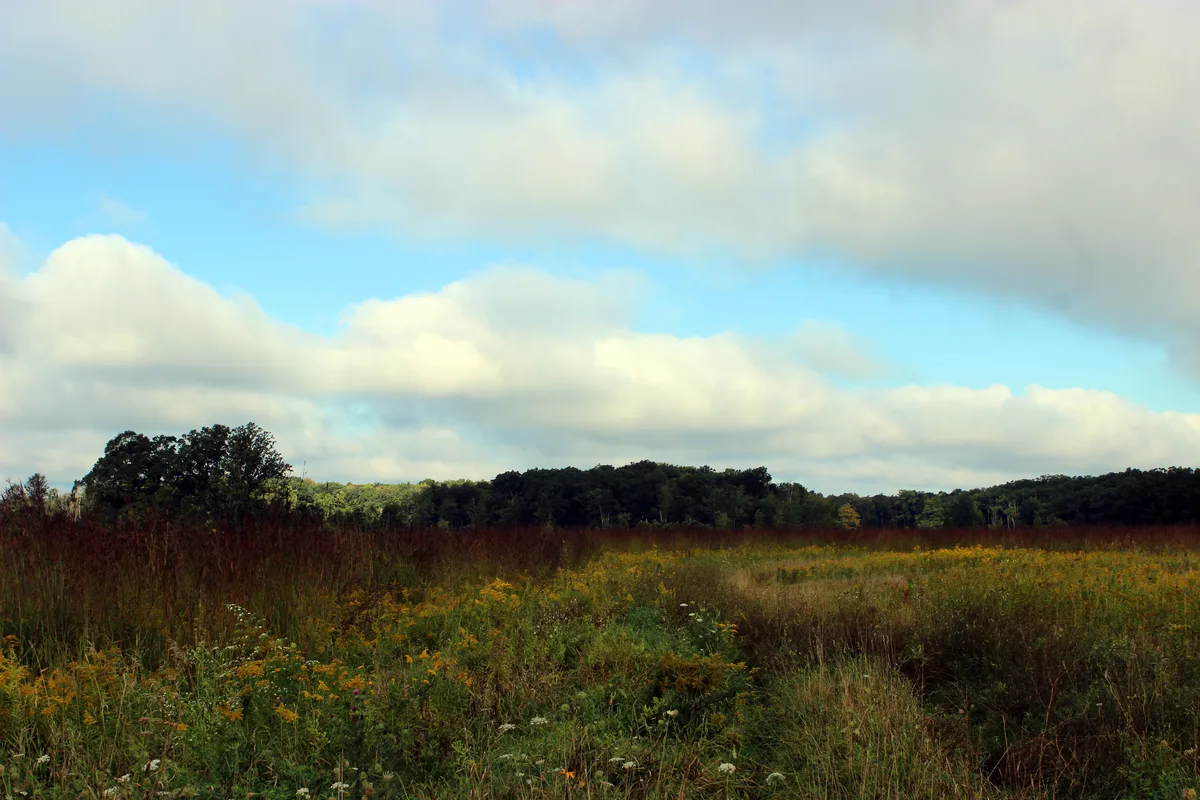
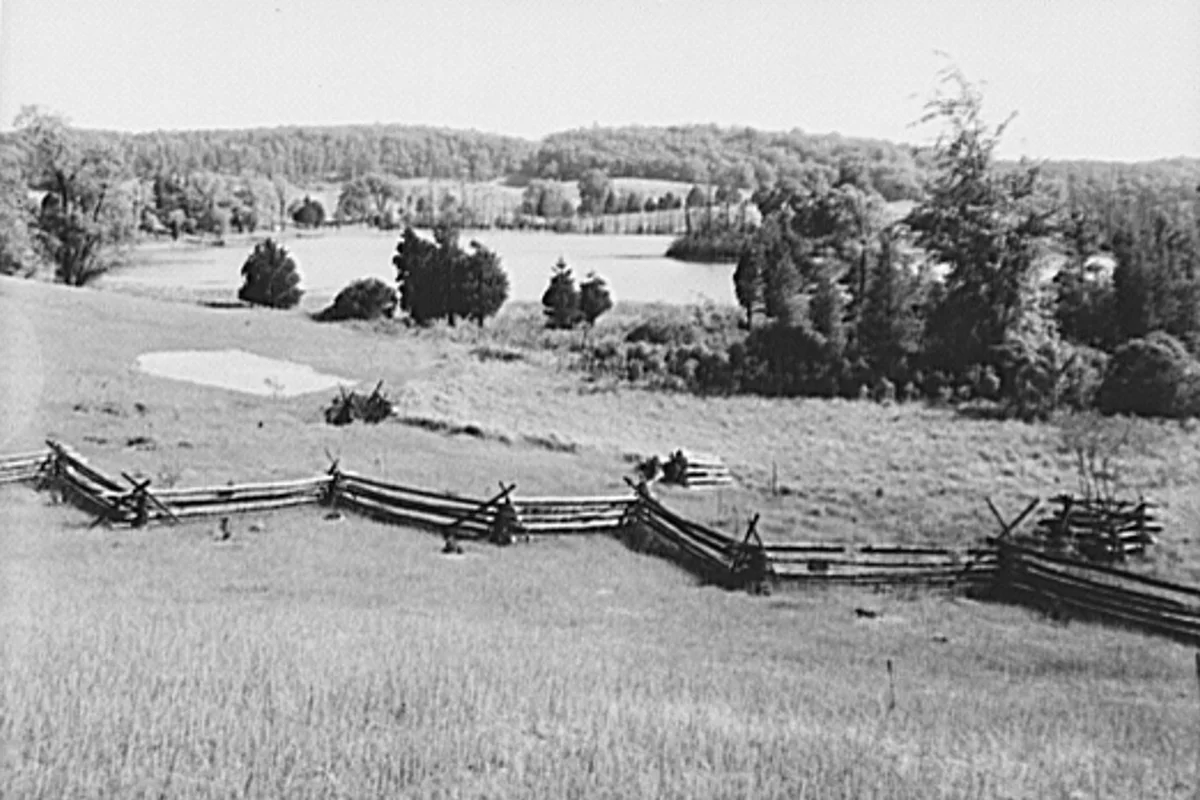
Drag the slider. The Waterloo tract in 1936 (Farm Security Administration · Library of Congress) and the re-wilded park today (USFWS). The POW camp stood on Maute Rd within this reclaimed land — these worked fields have returned to forest and meadow.
The camp footprint — picture what stood here
Illustrative layout of a typical CCC / WWII POW work camp — not a survey of this exact site. The real Camp Waterloo had the same DNA: parallel rows of wooden barracks along a central road, a mess hall, a wash house, and a small admin/guard building near the gate. Standing at the field, use it to imagine the footprint.
On the ground, look for
Foundation lines & concrete pads — rectangular outlines or slab fragments where barracks and the mess hall sat.
The old camp road grade — a flat, slightly raised lane running through the clearing.
Regular tree spacing or ornamentals — rows and non-native plantings often mark former buildings and walkways.
Scattered brick, concrete, or hardware — demolition traces. Photograph it; never collect — disturbing or removing artifacts on public land is illegal.
For real photographs, the Jackson County Historical Society's Camp Waterloo POW booklet and the Jackson District Library's local-history collection are the richest sources. The button below opens a quick image search.
Practical — coordinates, access & getting there
Coordinates
42.3148, −84.1655 (approx.)
Era
CCC camp 1939 (Co. 3695) → MP training → German POW camp 1944–45 → state prison, closed 2001 → cleared ~2013
Today
An open, cleared field along Maute Road; nothing of the camp stands
From you
—
Access & respect: The exact footprint is approximate, and Maute Road threads public park land and private parcels. View from the public road only — cross no fences, gates, or posted or active facility land.
Gravel From paved Clear Lake Rd (I-94 Exit 153), turn west onto Maute Rd — ~0.8 mi of loose, rutted gravel to the field. Crawl it or fold & walk. Park free on the Clear Lake Rd shoulder (no Passport); see Where to leave the car.
If you want the long view, this is the world that came before the camps — a beautifully kept 1840s farmstead that shows the settler life the Depression-era buyouts swept away. That's the whole reason this "marginal" land was free to become a park in the first place. It's a short drive northwest of the prisoners' field.
And that closes the loop — the entire arc on one patch of Michigan: the farms that failed, the Detroit kids who built a park, the enemy who waited out a war in the onion fields, and the slow return of the wild. Thanks for letting me walk you through it.
Practical — coordinates, access & getting there
Coordinates
42.37955, −84.17972
Era
1840s pioneer farmstead, preserved by the Waterloo Area Historical Society
Today
House and outbuildings open seasonally with separate admission — check ahead, it's volunteer-run
From you
—
Access & respect: Open seasonally with separate admission and volunteer-run — check ahead before counting on a visit.
Asphalt Paved county roads northwest — a pleasant ride, or a short drive from the POW field.
How an abandoned farm county became a park — and a prison
These rumpled hills are leftovers of the glaciers — moraines, kettle lakes, and bogs. Settlers broke the ground in the 1830s, but the soil never took to the plow, and by the depths of the Great Depression most of these farms were failing or abandoned. So the federal government ran a bold experiment: it bought up the worn-out land and, in 1935–36, set aside about 12,000 acres as one of the country's Recreational Demonstration Areas. It has grown past 21,000 acres since.
The plan was a neat two-for-one — give city families somewhere to get outdoors, and give out-of-work men honest labor. The Civilian Conservation Corps arrived — Company 3695 opened its camp on Maute Road in 1939 — and with the Works Progress Administration built the bones of the park you travel today: eighty to a hundred young men at a time, most from Detroit and paid thirty dollars a month, planting more than 350,000 trees, digging the fish ponds, raising the Portage Lake beach, and building permanent camps at Cedar, Mill, and Cassidy Lakes.
Then the war turned those same Depression barracks into a prison for the enemy himself.
Cassidy Lake's trade school had already passed to the Department of Corrections in 1942; Camp Waterloo, after training military police, was handed to the Army in 1944 to hold about 200 German prisoners. They were housed under the Geneva rules and put to paid work a short-handed home front badly needed — the onion and carrot fields, and a fertilizer plant fifty miles off in Lansing. Only one man, Eschweiler, ever tried to slip away, and he gave up three miles down the road; of the 6,000 Germans held across Michigan, only about twenty caused trouble. When peace came the prisoners went home, and the sites moved on to outdoor schools and a low-security prison that closed in 2001 and was cleared by about 2013. And one stubborn rumor to put to rest: there are no bunkers here and no tunnels — these were plain wooden camps, and the famous tunnel escape people half-remember was Papago Park, Arizona, not Michigan. What Waterloo has instead is rarer: Depression relief, wartime captivity, and a long return to the wild, all written on one patch of ground.